

Imagine in the future there is a ratio scale for intelligence, based on brain activity and measurements. Assume, like height, it has a near-perfect reliability. In other words, we find out how to directly measure intelligence. How much will that correlate with old g-factor scores?
To answer this question, we have to conceptualize intelligence well. Specifically, we need to know what it’s not, and see if something that is not intelligence causes differences in g-factor scores. One thing that impacts g estimates that is not intelligence is measurement error, but we’ll assume that is minimal, as the reliability of an average of several long g measures (for example multiple g scores extracted from WAIS trials, where each score has a reliability of around 0.90) approaches 1.
Is there anything in a perfectly reliable g measure, like an average of many g scores based on WAIS, that is not intelligence? I think there is. There are many people out there who claim IQs that don’t seem to match an accurate qualitative assessment of their intellectual output. Some of it is exaggeration (self-reported IQs only correlate with measured IQs around 0.30, and online people frequently lie about having taken real tests when they throw out a number), some of it is reliability, but some of it is probably that their g scores are really just inflated relative to their actual intelligence, because they come from backgrounds where people train for the test much more than average.
And there is evidence that training for the test works. One study found that merely taking the WAIS two weeks ago boosts a subsequent FSIQ score by 6 points. For people who train hard and who are at least average, the effect is even bigger.
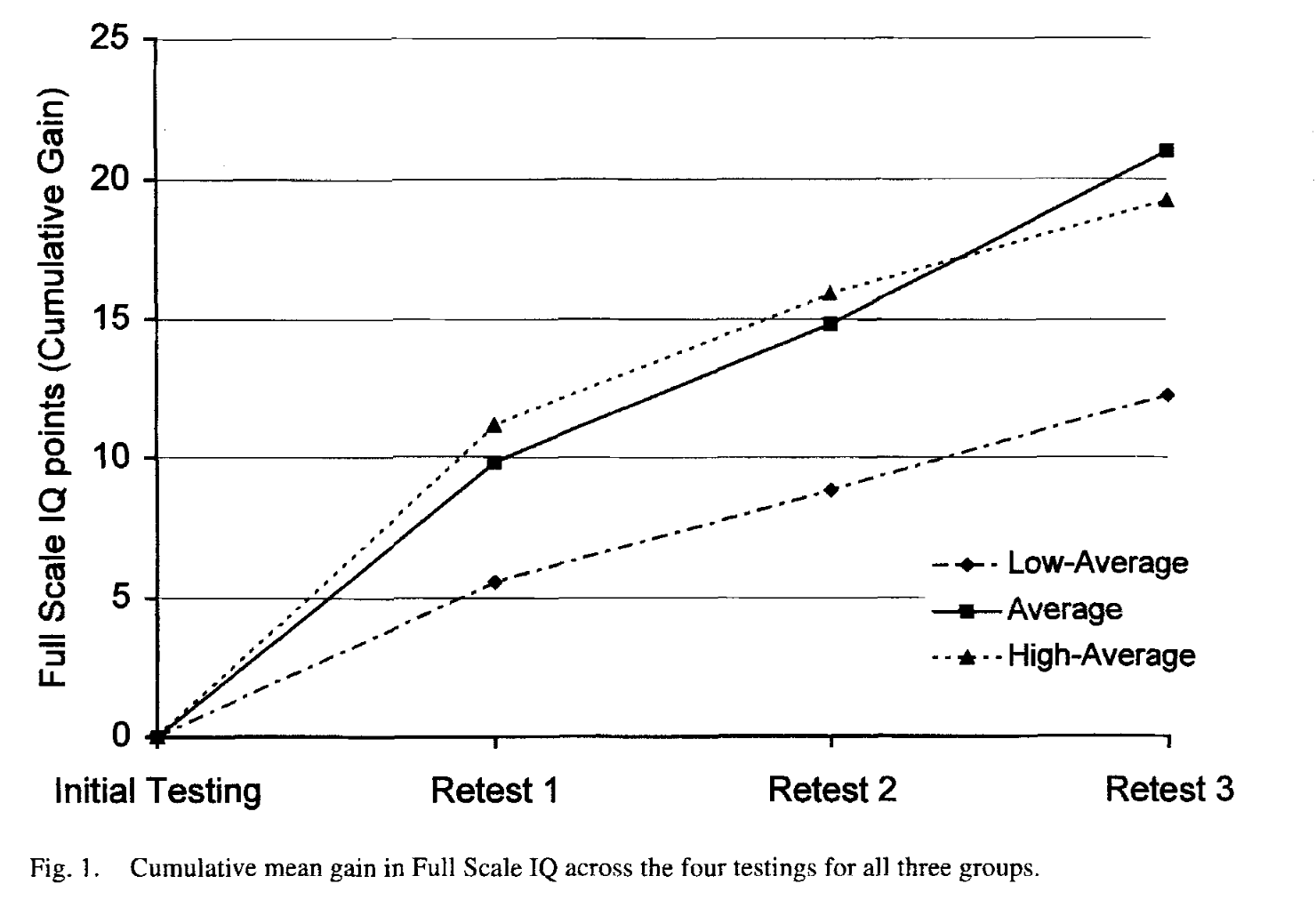
If 1% of people come from a culture of test training, and are scored on normie norms, their IQs can easily be inflated by 20 points. This won’t show up in reliability corrections; they can take tests again and again, and keep scoring 20 points too high. This would produce people who clearly think at the 125 IQ level, claiming to have scores in the 140s or even higher (but reliability analysis reduces their claims into the 130s or 140s, which is still higher than their real intelligence). I believe there are many such people on X and Substack.
Based on this data, I’m guessing practicing accounts for 20% of g variance with intelligence being the other 80%. That means intelligence and g would correlate at around 0.90. This seems broadly consistent with Arthur Jensen’s correlations between g-loadings and neural measures. It also means the correlation between practicing and g is about .45, or 6.75 IQ points per practice SD. Someone from a culture that is in the top percent of practicing should therefore have 15 to 20 points subtracted from their g score, to estimate their intelligence. This is consistent with the data from the figure above.
Additionally, there’s evidence differences in schooling, motivation, and need for cognition have small effects on g scores, usually around 5% of variance. That would sum to 15% of variance if they are all independent, a good chunk of our hypothesis.
I have also noticed that a lot of sketchy IQ claims come from people with “verbal tilts”. This may be because their training regime is verbal-focused. For example, the schooling and religious catechism of some over-training cultures emphasize verbal abilities while largely neglecting 3D shape rotating skills. When people from these cultures train, it should produce a tilt. Perhaps their spatial IQ scores are therefore better intelligence measures, despite having lower g-loading. They have lower g-loading, because g is in part training, and not loading on training reduces g-loading.
If this estimate is right, it should have application to the intelligence estimates of public figures. Once the g posterior is deduced from observed scores, one must mix in a prior for how much they trained. For many figures there is strong evidence of excessive training; for example, entering the SMPY, especially on math, at age 12, indicates humongous targeted training. Even 160 IQ 12 year olds don’t deduce high school math from first principles; they have to learn it from books, and even at 160 IQ many preteens would rather spend their time doing things that are more fun. Therefore, having gone through the books is a massive training effect, probably over 2 SD, and one could subtract 13.5 IQ points from the estimated IQs of SMPY participants based on this. Importantly, it’s probable that this would have to be done even from a highly reliable adult g-score, since the training effect actually changes their g, but not their intelligence.
Even a neutral prior for how much someone training introduces regression to the mean and uncertainty. 20% of variance in IQ means intelligence will tend to vary about 6.7 points around someone’s g scores, and a 0.90 correlation between intelligence and g means g scores shrink to the intelligence mean by 1.5 points. So, if someone has robust g scores of 140, using a neutral prior for their practice amount leads to an intelligence posterior for that person with a mean of 138.5 and a standard deviation of 6.7. That means there is a 1 in 50 chance their intelligence is really under 125, and a 15% chance it is really under 131. Alternatively, there is a 15% chance it is over 145 and a 2% chance it is over 151. This might help make sense of why there seem to be people who differ a lot in apparent intelligence even at similar g-score levels. For example, Richard Feynman claimed an IQ score of around 125, but his intelligence could have been in the mid to high 130s, even if that score was honestly reported. If it was unreliable then even the 140s are very possible. At the same time, a lot of people claiming 125 will come off a lot dumber than Feynman; their intelligence level can easily be under 119 given robust g scores of 125. This might lead to a 10 or 20 point intelligence gap between Feynman and someone else claiming the same g score, which seems to be the case in reality.
I've only taken an iq test once. Never trained for it. i came out 110. I've never had an issue with that. Being comfortable in your intelligence and what you know and don't know is liberating. I'm always the guy in the meetings asking questions when I think people are afraid to look stupid... I also meet people claiming to be 140. They must be tapping some serious G.
I have seen some estimates of the impact of training for IQ tests which suggested an impact of ~ half a standard deviation (~ 8 points) which is also consistent with training against g related tests - SAT/ACT. Now the populations in question may not be fully naive, so training may have somewhat higher impact for some populations. The bigger issue is g/IQ is a essentially capability that is valueless unless you use it. I have run across a lot of 'smart' people who seemed to have gotten out of the habit of using their intelligence.