
Jonathan Haidt Doesn't Care about Smart Kids
A dialogue with an elite high school student suffering from a phone ban

The following is an interview I conducted with an anonymous student at an American high school which banned phones started at the beginning of the current school year.
VOSS: Tell me about yourself. What grade are you in?
STUDENT: I’m currently in 11th grade.
VOSS: And how old are you?
STUDENT: 15.
VOSS: You are young for your grade level, aren’t you?
STUDENT: Yes, I have a tested IQ of 141. Last year, I scored a 1540 on the SAT. I skipped two grades, 2nd and 7th, because of being bored in class.
VOSS: So as a top student, what is your experience with the phone ban?
STUDENT: It’s terrible. For two reasons. The first is that the majority of my friends are online. The second is that I used it to learn more, and now I can’t do that in school, where you’re supposed to be learning.
VOSS: You think Jonathan Haidt was instrumental in this ban?
STUDENT: Yes, his name comes up a lot when I argue with people about it.
VOSS: So what would he say about your objections? Starting with, all your friends are online. Maybe he would say school isn’t the place for those friends.
STUDENT: He wouldn’t say that. I read his book, and he thinks school is for “socialization” as much as he thinks it’s for learning.
VOSS: Maybe he would say you should be friends with the people around you more instead, as a substitute? Maybe that’s better for the alleged “anxiety of the generation?”
STUDENT: Well, that’s paternalistic and presumptuous on his part to say the least. Who is he to know what makes me happy?
VOSS: It is paternalist, isn’t it? But he thinks he’s a genius psychologist or something, and that your age group deserves paternalism. He thinks you’re a child.
STUDENT: But that’s not really true and he’s not my parent anyway.
VOSS: He arrogantly thinks he knows better than you and your parents. As well as other experts like myself and Christopher Ferguson.
STUDENT: I think he’s a narcissist.
VOSS: He’s a demagogue whipping up a mob. He thinks because more than 50.0 percent of rabble agree with this inane ideas, he gets to lord over the dissenters. Do you know the definition of a demagogue?
STUDENT: A dictator in a democracy?
VOSS: It’s “a political leader who seeks support by appealing to the desires and prejudices of ordinary people rather than by using rational argument.”
STUDENT: Sounds like Haidt. His book had no reason in it. Just a bunch of misleading charts.
VOSS: I agree completely. You’re a reader of mine, correct? As I’m sure you’ve read from me, the causal impact of phones on teenage mental health is controversial. It might only be negative for girls.
STUDENT: I remember your article.
VOSS: And furthermore, even if Haidt’s effects are real, they’re just ATEs: average treatment effects. But he knows nothing about effect variance. It’s possible the effect on you of taking away your phone could be strongly negative, while being positive for the average person. In fact, there is evidence of this. Let me send you a chart.
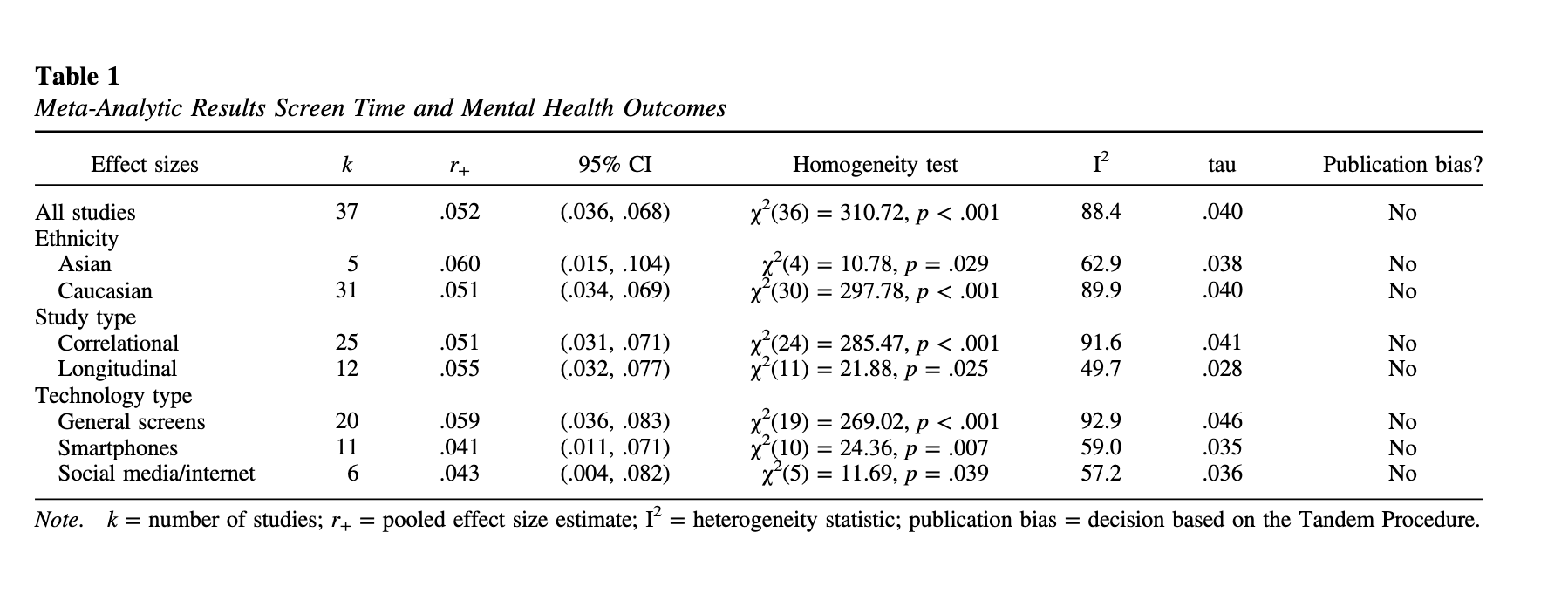
VOSS: It shows a homogeneity test for studies of teenage screen time and mental health outcomes. The null hypothesis is that the true effect of every study is the same. All of them fail the test, i.e. the null hypothesis is rejected. That can be caused by different things, but one cause is that the samples vary in important characteristics that correlate with Treatment Effect of phones on mental health. I suspect smart people actually gain from phones, while it might harm dumb people. If some samples have higher mean IQ because they are taken from schools of different SES (school mean IQs tend to differ much more than mere sampling would cause, people assort non-randomly on IQ geographically), that will cause the true effect of the study to differ from the true effect of a study on a low SES school. And the I^2 is the variance explained by true effect variance. You can see it’s above 90% for many of the measures. That’s huge. The ATE in this literature is almost meaningless.
STUDENT: So, what you’re saying is, we don’t know how a phone will impact an individual? It could make him happier or sadder?
VOSS: Yes. IQ test: when there is massive effect heterogeneity, should there be policy heterogeneity or policy uniformity? That is, if cigarrettes cure cancer for half of people, and cause it for the other half, should you ban cigarrettes, make everyone smoke them, or let cigarette use vary?
STUDENT: Obviously you should let it vary.
VOSS: Congratulations, you’re 15 and smarter than Jonathan Haidt and his gaggle of sycophantic supporters. Now let’s get back to the negative impact on you from Haidt’s intolerance for variance. Why might phones be good for you and bad for some others? Why are you not better off without your online friends?
STUDENT: My friends online are more like me. I can talk about intellectual things with them. I can’t do that with the people at my school. Talking to them gets boring.
VOSS: People tend to assort in friendship. Smart people want smart friends. Haidt making you be friends with the people that happen to be your age and live around you is like if I forced him to be friends with average people instead of other intellectuals and people that work at the heavily endowed neoliberal foundations like MacArthur as well as the universities he has had appointments at.
STUDENT: You’re making me get really mad at him.
VOSS: You should get mad. What do you think a good punishment for his specific demagoguery would be?
STUDENT: He should be without of all his money and positions for 3 years and forced to be friends with average people at a boring job where he can’t use his phone. He should be banned from social media entirely during that time like the laws in Australia.
VOSS: Exactly. This is what he recommends for others. As a narcissist he believes those others are beneath him because of their age. But many of those are above him, because they are more moral and more intelligent than him. If Haidt would submit to his own ideas, instead of yapping on X like he is above all 15 year olds, which he would have purged from such platforms with insane anti-privacy laws, with no regard for their specific abilities and desires, then I would respect him a lot more.
STUDENT: Haidt has seriously ruined this school year for me.
VOSS: But he would say it’s for the “greater good.” I’m sure that’s how he copes.
STUDENT: It might make some girls less obsessed with their bodies, girls who have terrible parents who don’t regulate their phone usage. But the harms are much bigger.
VOSS: I imagine miserable 130+ IQ young men who can’t access superior educational content could have very negative ramifications.
STUDENT: Exactly, I used to supplement my classes with all kinds of information. MIT Opencourseware lectures, books, YouTube stuff. I taught myself linear algebra from Strang’s amazing course last year. My school doesn’t have a linear algebra class, obviously.
VOSS: No high school does as far as I know. I’ve never heard of one. I think Haidt would say surely you are learning enough in school. Is that not true?
STUDENT: It’s not. Even in my classes, material is skipped, and there are better lectures online. The idea that my local teacher would be the best among the options I have with the internet is stupid. I’m taking AP Calculus BC and my teacher plays Khan Academy videos because she is uncomfortable with teaching infinite series and convergence and stuff like that. I’d prefer the MIT Opencourseware content but I can’t watch it at school anymore. Last year I would have and my learning would have been better. But my teacher can’t override the phone ban for anyone.
VOSS: I used to do that in school too. I taught myself a lot of computer science in high school. My high school only had AP CS which is not that good. When I got to university I already had mastered OOP and data structures and algorithms and was pretty good on operating systems. A lot of this was by coding on my personal laptop watching Youtube lectures. So a huge part of CS the core curriculum was redundant for me by the time I went to university. I would also read HBD material. For example the Mismeasure of Man, I read and critiqued that in school and I read Arthur Jensen’s Educability and Group Differences. And I’d read many papers. On top of that I read papers and books cited in my first book which I began writing when I was in 11th grade. If you think I sound distracted, I graduated as valedictorian with an associates degree worth of university credits and an IB diploma. And my high school had very very good resources, for example enough dual credit courses to do that in high school, which is often not the case. To this day I use the skills I self-taught at school, which I could only do having unregulated access to the internet through a phone or laptop. Are you allowed a laptop?
STUDENT: No, obviously not. You can watch Youtube Shorts and TikTok on a laptop.
VOSS: Do you feel that the phone ban is holding back your education? What about others?
STUDENT: Definitely. And my few irl friends feel the same. They are very intelligent.
VOSS: So what will you do, spend another year and a half there or try to graduate early?
STUDENT: It’s a difficult situation. If I drop out or graduate early I’ll lose my National Merit Scholarship. I’ve looked into transferring to an online program. In addition my family is talking with the school administrators to work something out where I can attend online or for partial days while taking courses at a local university campus. For example I may take AP Literature and AP Government at the high school, and Calculus 3, ODEs and physics at the college.
VOSS: So the escape options are obnoxious and costly?
STUDENT: Yes, and my irl social life is dependent on the school. I play two sports, cross country and track, and I won’t be able to do those next year if I don’t stay enrolled at this school. But I’d like to set a state record. There’s a chance I’ll be good enough to next year.
VOSS: Well it sounds like this moral panic has harmed you. I can’t think of any more questions. Thank you for your time.
STUDENT: You’re welcome.
VOSS: I’ll say one last thing before we stop: I don’t think all of this is one man’s fault. Many people have bad experiences with phones. Haidt has given those people a voice. But if he thinks what he has done is a morally positive thing, he’s gravely mistaken. At best he is doing this because it pays, in attention, status, and money. And that’s greed. It’s greed to not care about what is good, because you have the rewards of popularity to make up for the good. One last thing: do you and your friends think Jonathan Haidt cares about smart teenagers?
STUDENT: No. Definitely not.
I concluded the interview with that closing statement.
Thank you for sharing the interview! I agree with you that the debate around phones, youth, and education has become overly flattened. Average effects are treated as universal truths, and effect heterogeneity is often ignored. That said, I struggle with both the framing and the tone of your interview. There is a great deal of hostility in the exchange, and even as you criticize Haidt for whipping up a mob you do something similar by taking a 15-year-old and actively steering him toward anger and contempt for a single public figure (come on "what punishment should he get?”? You model hostility and then reward the student "“Congratulations, you’re smarter than Haidt…”). This doesn't doesn’t add clarity. It feels disproportionate, especially given the age and vulnerability of the kid involved. I was also bored in school. I also received top grades, and double degrees and what not, started school earlier. My parents took me out of one system and placed me in another. When I later returned to finish my exams in a public school, I spent much of my time sitting quietly doing higher-level mathematics on my own. Alone. No phone. Just books (didn't help my social life btw). We found books. Anyways, was it ideal? No. But it was a workable solution for a bored, curious kid, and one that didn’t require vilifying anyone. I don't think the problem is Haidt. It isn’t phones. And it isn’t that some intellectually advanced students benefit enormously from online content and communities (they clearly do). The deeper failure, I think, is that schools and governments are structurally unequipped to handle variance. When a child is significantly ahead, the default response is that’s unfortunate - as they actually only teach to the middle or the weakest link. In Denmark, where I live, there are one or two Mensa-style schools. That’s it. Bright children are the exception and yet we act surprised when they disengage, get frustrated, or seek learning elsewhere. The correct response to a smart student isn’t unlimited device access by default but neither is uniform restriction. It’s differentiated pathways, institutional responsibility, and serious investment in options that acknowledge cognitive diversity....Policy uniformity in the presence of massive variance is intellectually lazy. But replacing it with polemics doesn’t help. The challenge is design. Schools need to create structured autonomy, meaningful alternatives, and high-quality learning routes, online and offline, instead of outsourcing the problem to bans or to personal devices. Perhaps we'll see a rise of those with AI. Anyways I doubt they will do any of that tbf..But yes, the student’s frustration is real. It sounds disempowering and boring.
"... my teacher can’t override the phone [internet] ban for anyone."
The main problem here; need that flexibility.
A chunk of life is developing coping skills for boredom.