

I’ve always wondered how the financial system was designed. Why do we have such a complicated stock market? Aren’t derivatives a bit scammy? Even normal stocks can feel a bit convoluted.
I’ve slowly come to the conclusion that, like animals, the human economic market is a product of evolution. This is a significantly different viewpoint than that of mainstream economic theory. Mainstream economic theory holds that the economy is the result of a distributed reasoning process. There are many agents in competition, and they all behave in a way which maximizes their utility functions. Essentially, humans are modeled as agents that must use intelligence to find solutions to problems that optimize human scoring functions.
The evolutionary view holds that markets are mainly optimized not by human scoring functions, but by external scoring functions. Humans do blind trial-and-error to find optimal points. The extent to which human preferences shape the market is mainly the extent to which the market is shaped by human biological evolution, because human preferences are primarily evolved and hereditary.
That means that biological evolutionary pressures shape human market behavior. But exogenous pressures on physical processes also shape the market. You can see human intelligence as a way to quickly find optimal solutions when the function changes, but not as utility maximizers.
This sounds extremely abstract, so let me use an example: Tesla. We can think about Tesla like mainstream economists, or we can think about it as evolutionary economists. The mainstream view on Tesla is something like, they entered the market with a product P and a cost C, and they satisfy the market’s collective utility U. Where the product comes from and what the cost is is not really analyzed, and neither is utility. They get an equation with some big unmeasurable letters and a plus or a minus. A little to vague and simple, isn’t it?
The evolutionary view applies the sociobiological analysis of population traits to the market. It says there is some force or pressure on distribution of products and costs of those products. There is also going to be pressure on utility functions, for example, people can evolve, biologically or memetically, to prefer electric cars over gas more, all things held equal, and this will have an impact on the market. The rise of a company is therefore explained by this combination of pressures, like how the motion of a particle in physics is explained by the sum of forces on the particle.
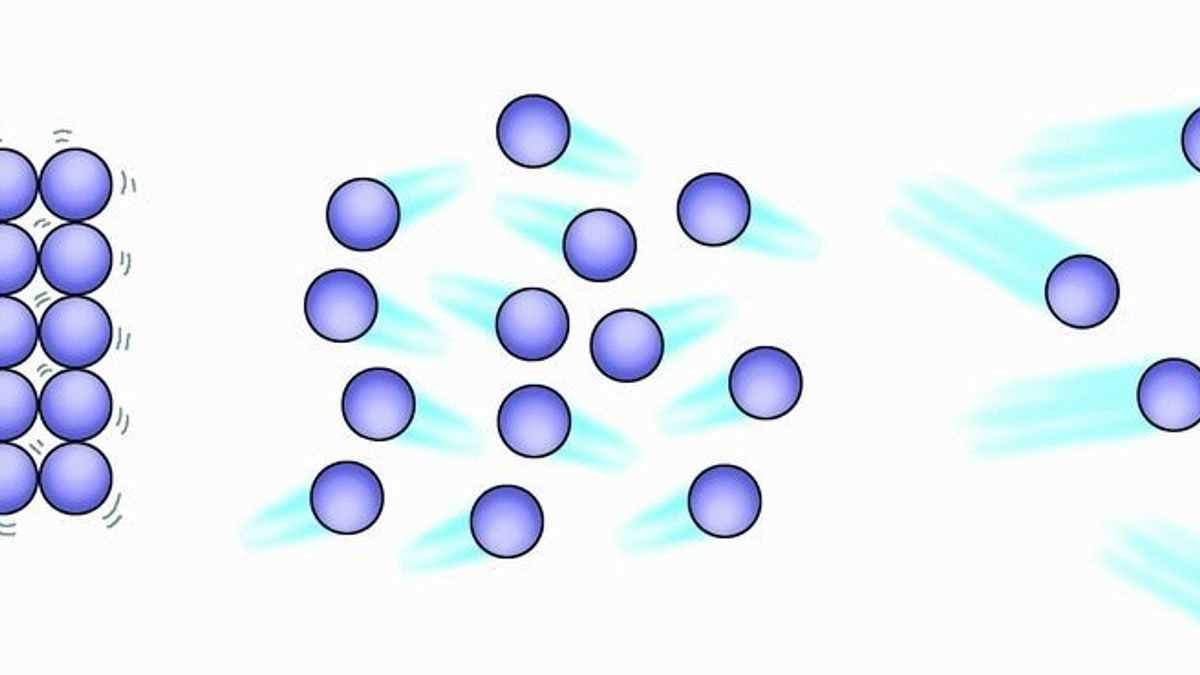
It follows that the rise of Tesla might be explained not by changes in the distribution of utility functions, but by changes in the production and cost spaces. You can think of these functions like probability distribution, or measurable spaces. Humans exert an opening pressure on the space. The production space starts out as 0 nearly everywhere, 10,000 years ago. In other words, there is no technology. More and more parts of it are increased above 0 by humans. Perhaps you could model the value of some part of the space as 1/cost of the production. The cost is infinity when production is impossible. As it becomes possible it may eventually become cheaper. As it becomes cheaper, it becomes more likely to be found in the market. The number can be interpreted as a likelihood of it existing.
Everyone intuits that technology development influences the market. But this is a neat way to formalize that intuition quantitatively, in a way that naturally goes with the rest of evolutionary theory. And this theory lends itself to measurement a lot better than neoclassical economics. In theory, you can measure the forces on the measure spaces and predict how they will change. Their change is the change in the market. Mainstream economic theory is more like a story that uses math than a measurement and prediction engine.
Now let’s apply this idea to trading. Trading models largely abandoned neoclassical theory and use something much closer to what I’m imagining. The value of a traded commodity is modeled as a stochastic process which is the measure of an underlying probability space. Quite simply, we want to think about the variance decomposition of the motion of the stochastic process. Some of it will be utility evolution, some of it will be production evolution, some of it will be exogenous shocks on the “measurable spaces” of those. For example, the Straight of Hormuz. A lot of recent motion in the oil market is explained by this. We could model the war as a pressure that compressed parts of the oil-commodity production space. This is in theory a successor to and generalization of the old notions of supply and demand.
The evolutionary theory also naturally produces neoclassical ideas like elasticity. When the oil area is compressed, it loses “likelihood.” That means other commodities gain relative likelihood. So they will become more “common” in the market as a result. Also, the sum of total costs^-1 decreases, so the sum of total costs increases. Thus, things are generally more expensive as a result. Mainstream economists call that cross-price elasticity.
So, the evolutionary view seems promising when it comes to generalizing disjoint parts of neoclassical economics and explaining them with math that is common to sociobiology. It also mechanistically links market changes to sociobiology through the evolution of U and explains other pressures on the market sometimes in the form of non-economic human behavior, like war. This integrates economics with sociobiology, which is a huge upside. Conceptually, economics should be a subcomponent of sociobiology, since it’s ultimately about the behavior of biologically evolved humans.
It would be interesting to try to formalize this idea, and maybe submit it somewhere like arXiv. There is already a minority field that calls itself evolutionary economics, but it doesn’t like like it’s exactly what I have in mind. Some recentish literature, for example, seems to support the idea that markets have evolving moments, by making “market efficiency” such a moment and showing that it changes, whereas mainstream economics just says it’s static apparently. By efficiency they seem to mean the predictability of future return: perfect efficiency is supposed to mean that the next price cannot be predicted by past prices. Apparently bitcoin has long term swings that come and go, sometimes it moves randomly and sometimes there’s a predictable longterm trend. Well, why is that? It sounds like there’s coming and going evolutionary pressures on bitcoin. Sometimes they persist for a while and then fade. So I suppose this is empirical evidence for my model, although it’s not clear where the focus on efficiency should come from. I suppose my theory might not formally predict market efficiency, rather it would say it’s not that important and it goes up and down, while mainstream economists have a foible of obsession on equilibrium and efficiency. But the underlying theory I’d like to see developed is more or less ignored on the paper, instead the probably irrelevant idea of efficiency is fixated on, with reference to the “Efficient Market Hypothesis” as the alternative hypothesis, become “debunked,” but in a sort of atheoretical, negative way. I much prefer to produce a substantial counter theory which implies this result, and then use the result as support for the theory, instead of acting as a “debunker.”
But it seems like there are some good papers in evolutionary economics nonetheless. The field seems split between people more aligned with a classical evolutionary approach, which is what I’m advocating for, and people who would like to strip it down and seemingly subordinate it to neoclassical economics:
The term “evolutionary economics” might have been first coined by Thorstein Veblen.[1] Veblen saw the need for taking into account cultural variation in his economic approach; no universal “human nature” could possibly be invoked to explain the variety of norms and behaviours that the new science of anthropology showed to be the rule rather than an exception.[16] He also argued that social institutions are subject to selection process[17] and that economic science should embrace the Darwinian theory.[18][19][20][1]
Veblen’s followers quickly abandoned his evolutionary legacy.[16][21] When they finally returned to the use of the term “evolutionary”, they referred to development and change in general, without its Darwinian meaning.[1] Further researchers, such as Joseph Schumpeter, studied entrepreneurship and innovation using this term, but not in the Darwinian sense.[2][22] Another prominent economist, Friedrich von Hayek, also employed the elements of the evolutionary approach, especially criticizing “the fatal conceit“ of socialists who believed they could and should design a new society while disregarding human nature.[23] However, Hayek seemed to see the Darwin theory not as a revolution itself, but rather as an intermediary step in the line of evolutionary thinking.[1] There were other notable contributors to the evolutionary approach in economics, such as Armen Alchian, who argued that, faced with uncertainty and incomplete information, firms adapt to the environment instead of pursuing profit maximization
A book from the 80s is credited with being seminal to the field of evolutionary economics. It promotes the use of Markov chains for modeling:
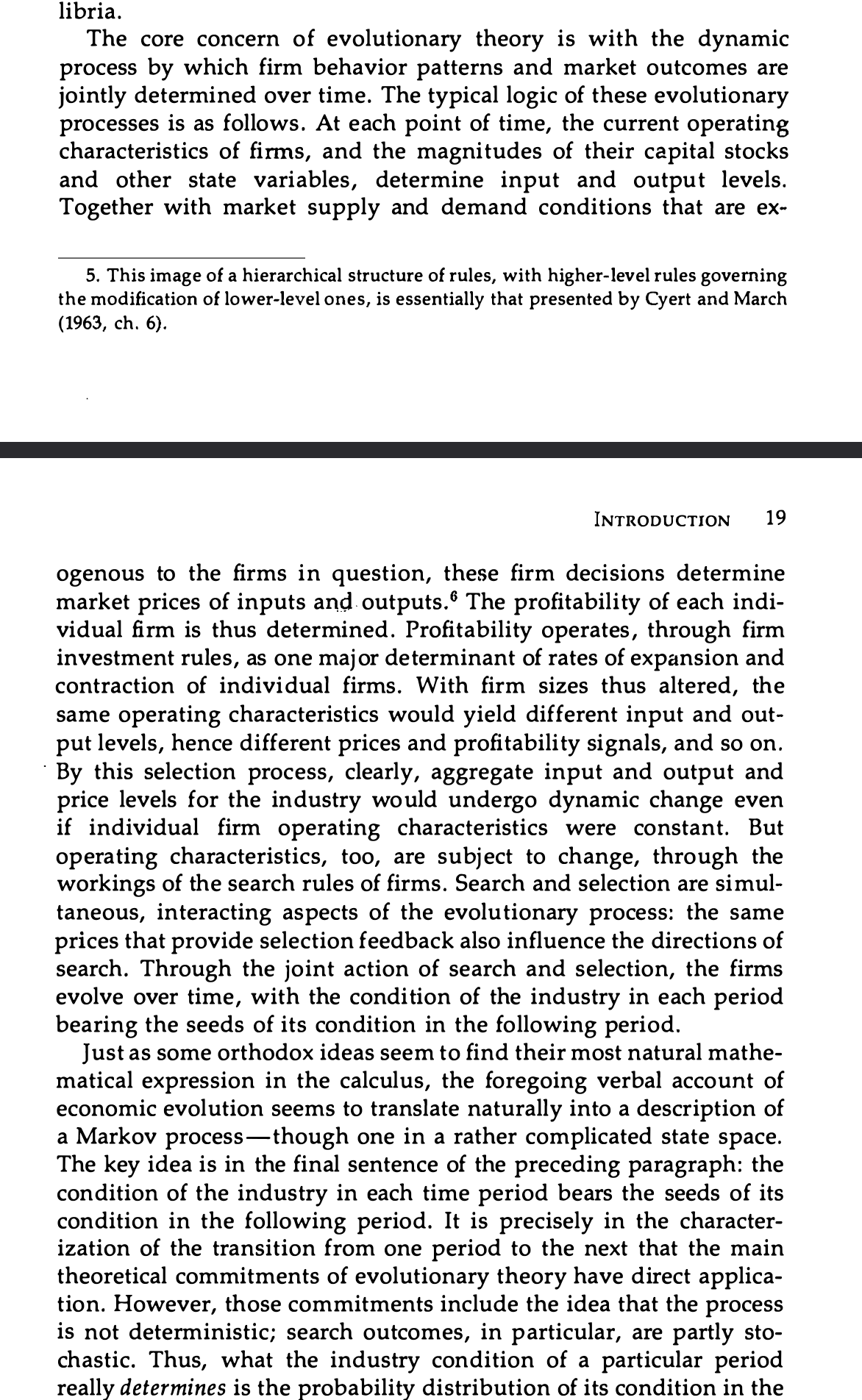
I would say this is a step in the right direction, but it’s not enough. The Markov property is very general and not sufficient for modeling evolution. It says that the next state of a stochastic process is sufficiently predicted by its current state, and no states before that. That’s not enough to break down evolutionary pressures. Evolutionary systems trivially depend on the current state and the pressures on that state, and not past states. I’m also not thrilled with the use of terms like supply, demand, capital stocks, and so on. I would like to replace these terms ,which came out of neoclassical theory, with superseding evolutionary terms, like I outlined above. I’ve always had the intuition that those terms hide a lot of important phenomena and complexity and they don’t really give me what I’m looking for when it comes to economic theory, like heritability does in behavior genetics.
It sadly shut down a while ago, but i can highly recommend the journal of bioeconomics (https://link.springer.com/journal/10818/volumes-and-issues). Not every paper is directly related to what you have in mind, but i guess you would find some good ones in there, for example one which links sexual selection and conspicious consumption to economic growth --> https://link.springer.com/article/10.1007/s10818-015-9200-9
First